Category Strategy Engine by Christian Schuh
Built by Christian Schuh, creator of The Purchasing Chessboard
Category Strategy Engine
Most procurement software improves execution. Category Strategy Engine helps you choose the right strategy first.
15
Structural Factors
100M+
Market Configurations
64
Sourcing Methods
Procurement Digitized Execution. Strategy Is Next.
For three decades, procurement technology focused on execution: workflows, sourcing events, contracts, supplier communication. But the most important procurement decision remained largely informal:
What sourcing strategy should we pursue in this category?
This question depends on the structure of the market — the relative position of buyers and suppliers and the competitive dynamics between them. When the diagnosis is correct, the right processes follow naturally.
When it is wrong, organizations execute the wrong strategy efficiently.
Category Strategy Engine introduces a new decision layer for procurement. Built by Christian Schuh — creator of The Purchasing Chessboard and one of the leading voices in procurement strategy over the past three decades — it encodes deep domain expertise into a structured, explainable decision system.
For the first time, procurement organizations can operationalize strategic sourcing expertise at scale — independently of the experience level of individual buyers.
How It Works
The Purchasing Chessboard describes 64 sourcing methods available to procurement organizations. Category Strategy Engine applies the logic of this framework in a computational decision model.
The engine evaluates the structural balance of power between buyers and suppliers to identify the most appropriate sourcing strategy. Two forces determine the position:
Demand Power
Structural strength of the buyer
Supply Power
Structural strength of supplier markets
Strong buyer influence may enable leverage strategies. Strong supplier markets may require dependency management. Balanced positions may call for collaborative or innovation-based approaches.
Market structure
15 structural factors · 106,168,320 possible configurations
Structural position
Demand power × Supply power
Strategic landscape
Purchasing Chessboard · 64 sourcing methods
Procurement action
Recommended method · Adjacent options
64 Methods. Most Companies Use Fewer Than 15.
In practice, many procurement organizations default to a narrow set of sourcing methods — particularly those in the lower-right quadrant: competitive bidding, benchmarking, cost breakdowns, and global sourcing. While often appropriate, relying on them too frequently means other powerful strategic options remain underused.
Category Strategy Engine ensures the full range of strategic options is considered before execution begins.
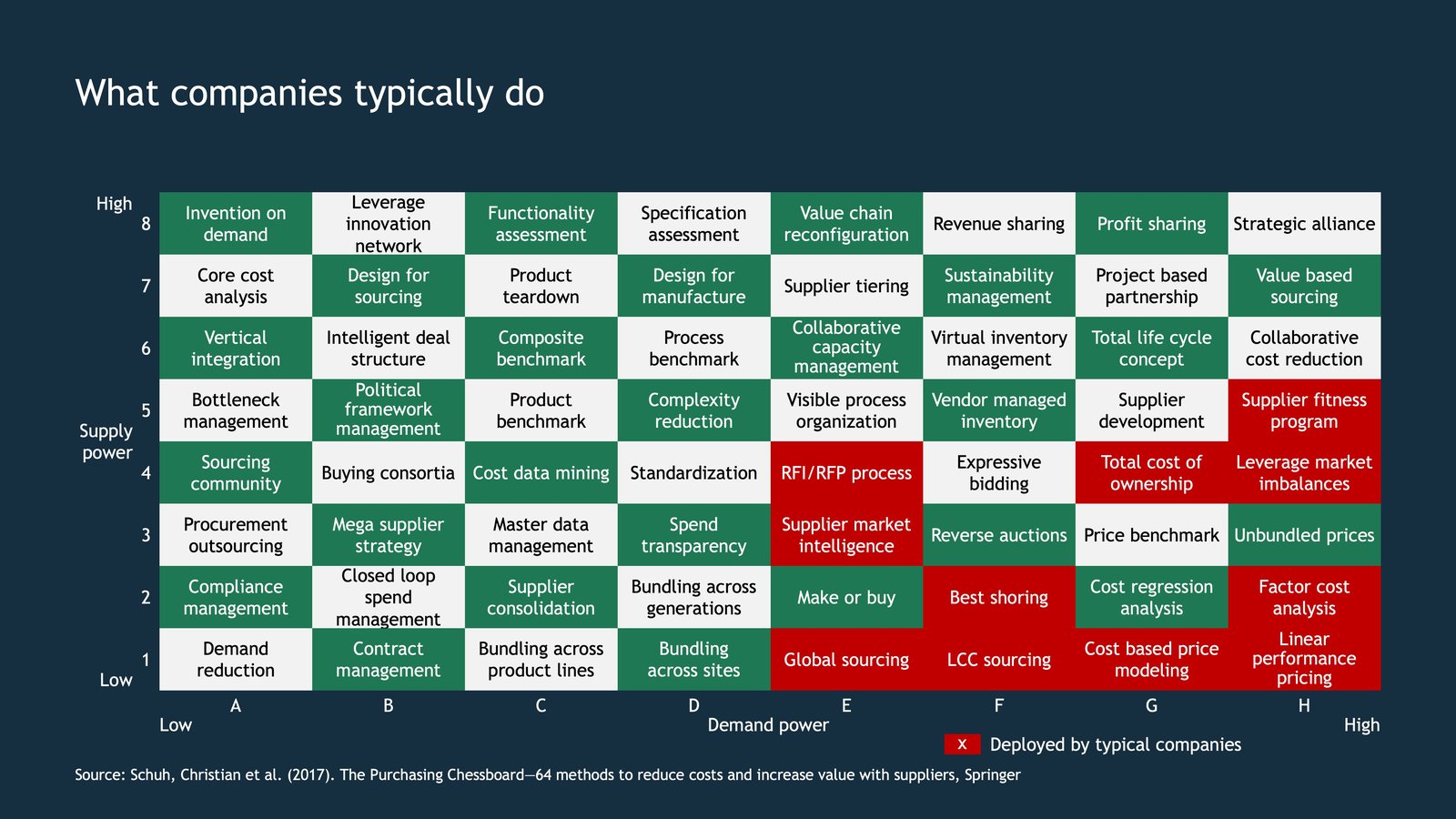
Red cells show methods typically deployed by companies — concentrated in the lower-right quadrant. The majority of the Chessboard remains unused.
Structural Market Diagnosis
Category Strategy Engine evaluates 15 structural market factors that influence the structural position of buyers relative to suppliers.
Demand Power — 9 Factors
Industry dominance
Supplier circumvention risk
Growth perspective offered to suppliers
Competency enhancement potential
Reputation benefits for suppliers
Buyer position within the industry
Innovation collaboration intensity
Buyer Share of Supplier Market
Supplier Customer Base Breadth
Supply Power — 6 Factors
Technology uniqueness
Supplier concentration
Capacity utilization
Switching costs
Entry barriers
Availability of alternative technologies
These structural factors consistently shape the balance of power between buyers and suppliers across industries.
The interaction of these factors creates a vast range of procurement situations across industries and supplier markets. Category Strategy Engine translates this complexity into structured and explainable strategic recommendations.
Encoded Procurement Expertise
Each of the millions of market configurations maps to a specific strategic neighbourhood within the 64 methods of the Purchasing Chessboard. This mapping — from structural situation to strategic recommendation — constitutes the core intellectual property of the Category Strategy Engine.
The architecture of the system is straightforward. The knowledge embedded in the mapping is not.
Category Strategy Engine translates structural market economics into executable procurement strategy.
The result is a system that delivers what most procurement organizations lack: consistency in how strategies are selected, transparency in why a method was chosen, and continuity when people change roles.
Category strategy development moves from individual expertise into institutional capability.
From Strategy to Execution
Category Strategy Engine does not replace judgment. It structures the reasoning that precedes it.
1
A procurement team begins a sourcing initiative.
2
The category is evaluated using the 15 structural factors.
3
The engine derives a structural position and identifies the sourcing methods that fit.
4
The recommendation is reviewed with category leadership.
5
The team follows the recommendation — or consciously deviates, documenting why.
This process introduces what most procurement organizations still lack: structure, discipline, and traceability in how sourcing decisions are made.
When buyers rotate roles — as they regularly do — the strategic logic is preserved. New category managers inherit a diagnostic framework, not a blank page.
When experienced category managers leave, strategic logic is often lost with them. Category Strategy Engine transforms sourcing strategy from individual know-how into organizational capability.
A New Software Layer for Procurement
Category Strategy Engine is not another sourcing workflow tool. It is a strategic reasoning layer for procurement.
Most procurement technology operates in the transactional layer: managing workflows, monitoring contracts, orchestrating sourcing processes. These tools improve execution.
Category Strategy Engine operates at the level of strategic reasoning. It supports the decision that shapes procurement activity before execution begins. The reasoning is deterministic and explainable — when the engine recommends a method, it shows why.
In strategic sourcing, recommendations must be explainable. Procurement leaders need to understand not only what strategy is recommended — but why. This makes every recommendation defensible, auditable, and open to challenge.
Procurement has spent decades digitizing transactions. Strategy is next.
The Engine in Practice
Category Strategy Engine has been applied to a growing number of real-world procurement categories and is currently being explored across multiple industries as organizations search for more structured approaches to category strategy.
Each analysis produces a full strategic briefing — including structural diagnosis, chessboard positioning, recommended method, adjacent strategic options, and implementation guidance.
Categories analyzed include:
- Aluminum Cans — Beverages
- Coffee — Food & Beverage
- OLED Panels — Consumer Electronics
- Logistics — E-Commerce
- Castings — Aerospace
- Fleet — Specialty Chemicals
- Semiconductors — Automotive
- Packaging — FMCG
Category Strategy Engine combines three layers in every analysis:
AI-assisted market intelligence
Establishes a research baseline from publicly available market data.
Human calibration
The procurement professional reviews and adjusts parameters based on domain knowledge.
Deterministic procurement logic
Maps the calibrated inputs to a recommendation using the logic of the Purchasing Chessboard.
Experience Category Strategy Engine
The next frontier of procurement technology is not faster execution. It is better strategic decisions.
Category Strategy Engine is available in three formats:
Strategic Buying Accelerator
A 90-day capability transformation program. Participants work on real categories using the engine, with direct coaching by Christian Schuh.
€150,000
Pilot Deployment
A focused pilot at category-team level, with hosted web access for a defined group. The fastest way to prove the engine on your own categories.
From €75,000
Category-team pilot · hosted web access
Enterprise Deployment
Organization-wide access across categories, regions, and teams — via hosted web access or API integration into your own procurement stack. A shared strategic language for sourcing decisions, deployed at scale.
Custom
Structured per deployment
Category Strategy Engine
Helping buyers, VPs, CPOs, and CEOs unlock the strategic potential of procurement.
bychristianschuh.com · LinkedIn · YouTube
Based on the methodology of The Purchasing Chessboard (Schuh et al., Springer 2017)
© 2026 by Christian Schuh. All rights reserved.